Past and future revolutions can be dissected in a variety of different ways. This attempts to show it in terms of industries that will arise, that will cheapen the price of everything to free, or near free for practical purposes, to the point that there would be absolutely no effort needed to live, and have relatively unlimited wants met.
The future may look something like this.
What does a person need to live comfortably? A house, food, and clothes. Could these all be free someday?
- Your robot uses AI to design a completely passive house (requires no energy) from scratch
- It grows all your own food in a garden, using hyper-productive methods, so all your food needs are met. Meals can be of any quality.
- To build the house, it either uses nearby raw materials, or it takes dirt/organic matter and modifies the molecular materials (you can create plastic from plants) through chemical and direct manipulation of molecules to convert them into various alloys and synthetic building materials, then it proceeds to build your house for you.
- The same methods are used to create your clothes
- All education is free as well obviously
- It recycles everything
- Last, but not least, it builds you a miniature energy reactor that provides unlimited energy from a handful of sand.
- Who fixes the robots you ask? Robot 1 fixes robot 2, and vice versa. They can create building materials to replace parts (3d printed circuits are coming).
This is the goal we are slowly heading towards, so if there is one positive thing about the future, it’s that we may not need all the businesses, advertising, buildings, roads, government resources, transportation of materials, energy waste, and other waste. But the tradeoff might be that nobody needs to associate with each other either, other than for social competition.
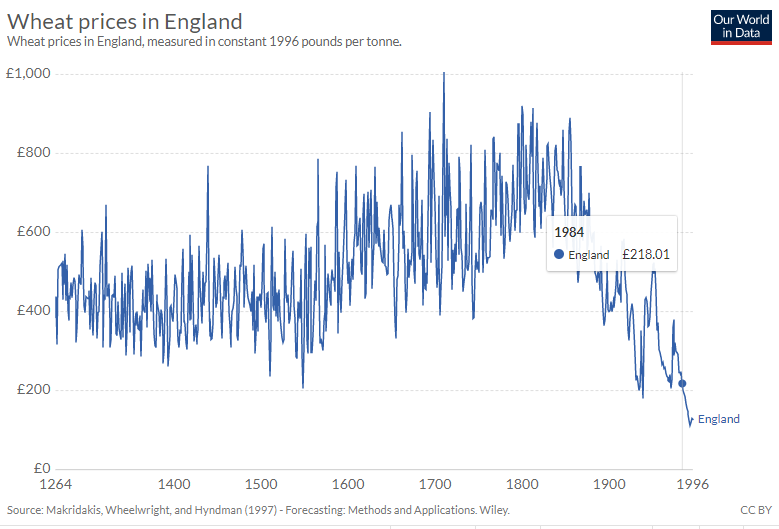
How can I be sure this is going to be affordable? I know most people think life is getting more expensive, but the reality for basic living needs, and when adjusted for inflation, is actually the opposite. You can see it in the long term, inflation-adjusted food prices. Here are wheat prices for the last 800 years in England. Notice what the industrial revolution did:
And it’s not just wheat prices:
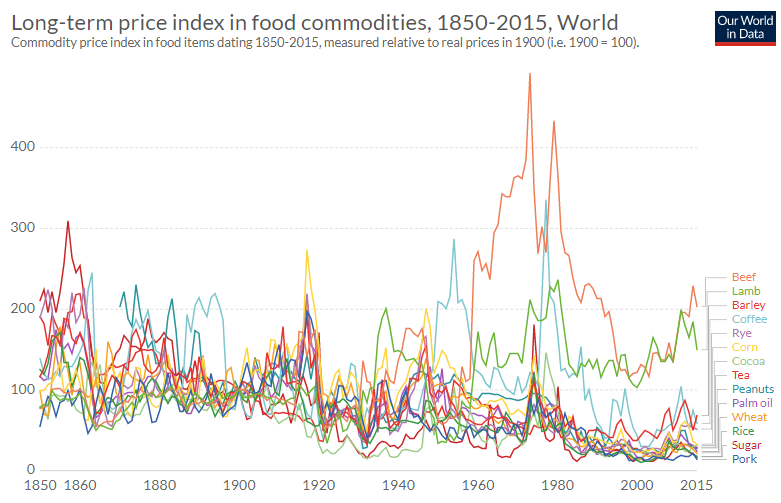
With greater automation and efficient tools, all products/services/etc… will get cheaper with time, as long as there is an incentive to create such tools. While basic commodities like food are getting cheaper, other areas like healthcare are getting more expensive over time, but the most basic health services are declining with time, and will eventually be followed by a commoditization of even more advanced health (E.g. cancer cures will be free). At least free market industries always go that direction over time.
So, what are the future ages that will cause everything to be free:
- Age of knowledge –> free information, knowledge (via books, computers, AI)
- Age of labor –> free labor (beginning with machines, factories, ending with robots)
- Age of biology and nature –> free medicine, curing disease, and modifying life (biotech)
- Age of materials creation –> free materials
- Age of energy –> free energy
Of course, there is no real beginning nor foreseeable end to any of these ages either. The abacus was a non-silicon based computer and nanotech started 1000’s of years ago–will the computer ever stop developing? perhaps.
First Revolution: Industrial (Machines)
The first industrial revolution included the factories, globalization, and most of all: engines x automation. It produced more goods for less.
Second Revolution: Information (Computers)
Or the “digital age”
Computers do two things: calculate and store information in the form of 1’s and 0’s, or simply digits. Even an image on a computer screen is made up of millions or billions of 0’s and 1’s.
Connecting two computers (networks) lets you share information. So, I am grouping both the growth of computers as well as data and networking (e.g. internet), because seems unlikely to have one without the other.
The Internet of Things is simply an extension of networking small computers on to everyday objects.
Future Revolutions
One of the challenges to predicting the future is the fact that there are already several revolutions underway, and are happening simultaneously, so this is not an attempt to determine the exact order in which they will happen.
Third Revolution: Biological
Other names for the biological revolution include “biotech revolution” and “gene revolution”
Fourth Revolution: Materials (Nanotech)
Or the age of microscopic miniaturization.
Nanotech is simply a continuation of what we have been doing for hundreds of years, which is shrinking tools and machines smaller and smaller. Maybe we will never shrink people like in the movie Fantastic Voyage, but robots so small that they could replace your blood cells is a dream that many think is feasible.
In fact, miniature, self-replicating robots are considered one of the existential risks to humanity, and is referred to as “the gray goo problem.” There are several book written about it, but it’s easy to think of it as a real-world virus, if designed poorly or maliciously.
Fifth Revolution: General Labor (Robots)
While factories automated specialized tasks, robots promise to automate virtually any task. Such a machine is unique in that if there is a job that you can do, it will do better, and probably cheaper.
If you think robots will be expensive, they will be but only at the beginning, just like how computer chips get cheaper with time “A computer chip that “… “cost $1,000 in 1970,” … “costs less than $0.02 to manufacture today “. Why? because more people will demand them, and that creates an incentive to make them cheaper. Consider that the first cell phone cost 1000’s of dollars, and that was only taken a decade or two to drop to prices reachable around the world.
Sixth Revolution: General Intelligence (
Most technological progress has been mainly the result of a few common, and direct elements:
- Using simpler tools to build more complex tools
- Better understanding and manipulating materials (chemical)
- Miniaturization of mechanical tools
I want to focus on the last one. As tools get smaller, we can create precise control over increasingly small processes, which is why the future is heavily focused around microscopic and nanoscopic tools.
Even the increase in computing power for so many decades has been mostly about shrinking transistors, with the goal of fitting as many as possible on to the same area (and BTW, chip makers are currently approaching a fundamental limit of physics).
Likewise, nanotech and biotech require smaller and smaller tools, like the new gene-editing tools. Scientists can directly modify DNA. Some futurists hope that we can directly manipulate atoms cheaply.
 HumanIT