” Yet there is no country and no people, I think, who can look forward to the age of leisure and of abundance without a dread. For we have been trained too long to strive and not to enjoy. It is a fearful problem for the ordinary person, with no special talents, to occupy himself, especially if he no longer has roots in the soil or in custom or in the beloved conventions of a traditional society. To judge from the behaviour and the achievements of the wealthy classes today in any quarter of the world, the outlook is very depressing! For these are, so to speak, our advance guard-those who are spying out the promised land for the rest of us and pitching their camp there. For they have most of them failed disastrously, so it seems to me-those who have an independent income but no associations or duties or ties-to solve the problem which has been set them. “
John Maynard Keynes – Economic Possibilities of Our Grandchildren
Some argue Keynes was the father of modern, American economics (I disagree with some of it myself), so I wanted to discuss some of his ideas from his paper that suggested that we would become so rich, that we would not know what to do with our free time.
Mankind has lived to work, to be challenged, and to desire some leisure, but what will leisure mean if there is no challenge?
- The greater the challenge, the greater the reward.
- The greater the pain, the greater the pleasure.
- The greater the effort, the greater the relief from that effort.
But perhaps there are opportunities, as he thinks we will chase money less, and avoid the vice of interest (which only works if you offer/sell debt).
I see us free, therefore, to return to some of the most sure and certain principles of religion and traditional virtue-that avarice is a vice, that the exaction of usury is a misdemeanour, and the love of money is detestable, that those walk most truly in the paths of virtue and sane wisdom who take least thought for the morrow. We shall once more value ends above means and prefer the good to the useful. We shall honour those who can teach us how to pluck the hour and the day virtuously and well, the delightful people who are capable of taking direct enjoyment in things, the lilies of the field who toil not, neither do they spin.
But is spending all your time crafting and hobbying sound enjoyable or meaningful? What are the chances that most will either become utterly lazy, live in a video game with artificial goals or simply be bored, or entertained, to death. In case you have not noticed, the process is already underway.
Keynes said this process was already underway in 1930. Personally, I saw it decades ago as well.
I look forward, therefore, in days not so very remote, to the greatest change which has ever occurred in the material environment of life for human beings in the aggregate. But, of course, it will all happen gradually, not as a catastrophe. Indeed, it has already begun. The course of affairs will simply be that there will be ever larger and larger classes and groups of people from whom problems of economic necessity have been practically removed. The critical difference will be realised when this condition has become so general that the nature of one’s duty to one’s neighbour is changed. For it will remain reasonable to be economically purposive for others after it has ceased to be reasonable for oneself. The pace at which we can reach our destination of economic bliss will be governed by four things-our power to control population, our determination to avoid wars and civil dissensions, our willingness to entrust to science the direction of those matters which are properly the concern of science, and the rate of accumulation as fixed by the margin between our production and our consumption; of which the last will easily look after itself, given the first three. Meanwhile there will be no harm in making mild preparations for our destiny, in encouraging, and experimenting in, the arts of life as well as the activities of purpose.
The most interesting point here is ” For it will remain reasonable to be economically purposive for others after it has ceased to be reasonable for oneself” because perhaps my greatest concern is that when we have everything we need, we will not need each other.
You can see this in rich people today, and wealthy areas such as cities. You can also expect the rejection of people as we all get “richer” which I define elsewhere. I can use the internet now to learn almost any basic skill and AI is accelerating that, so the last thing I need is a real person to help me with anything. Clearly, with machines, all our needs from building a home to getting treated medically will be done with robots and AI.
But you say it is a real person on the internet? Yes, but not for long, and besides, these are not neighbors, nor people closest to us. More importantly, it will continue to erode geographically close, and physical (real), relationships. Some people think the ideal future is living in a Matrix, where we live in a fantasy full time, with perhaps the Metaverse being one of the early incarnations of such, but somehow that seems shallow to me, but as all real work is automated, why would many people not choose to live in fantasy full time? Perhaps the majority would. Again, just look at the trends I listed here and assume they will expand with more free time, more realism, and more personalization.
When we get advanced information/education (AI) and free labor (robotics), that will seal the deal. Only societies that do not have their economic needs met, or at least not outsourced to advanced technology, will continue to need each other. And this is not limited to neighbors, but all social units. Families will not need each other, and populations may even be unlikely to need govt, but that is a difficult problem to discuss here.
Is there evidence today that this is already happening? Communities continue to decrease, families spend less time than ever, and I am lucky to hear back from my neighbors when previously I lived in urban environments.
One argument some make is that technology does not necessarily disconnect us, which is true, but I show the reality of facts, that they do on average, and we should avoid the exceptionalist thinking known in social science as “illusory superiority,” which demonstrates that for example, 90 percent of professors rate themselves as above-average teachers.
When Will The Age of Leisure Happen?
Keynes believed this would happen within 100 years (2030) and that does not seem too far off. And yet, technology marches forward…because it has to. Nothing can stop it, except a partial or complete rejection of technology, followed by a rejection of science, and ultimately, The Enlightenment (a.k.a. Age of Reason). All of this has brought untold wealth, which brings up the question: when does materialism become a problem? I know there are a lot of people worried about starving in far-off countries. I am one of the few more worried about the opposite in nearby places.
The promise of AI (generalized mental work) and robots (generalized physical work) is that no one will need to work again. Of course, materials scarcity will still exist, for a time, but generally speaking, productivity rates are about to skyrocket.
What Does this Mean for Materialism?
A common critique of the modern age says that the age of science and reason may, like all other ages, come to an end at some point. This does not seem unsurprising in some sense. While we all want things like medicine, at what point will our demand far exceed our needs, making us useless materialists and hedonists? Based on how many toys some of us own, and also time spent in media/video games, we are already there.
In other words, if we stopped buying more material goods, and experiences, the economy would probably slow tremendously. The eternal 7% stock growth projections do not seem wise (materialism) nor feasible (slowing population). Many have pointed out that Disny’s Wall-E may be the best description of the future if current trends continue. Even I ask my kids to pick my phone up off the ground when it’s only 4 feet away from me–clearly, I am contributing to the laziness problem.
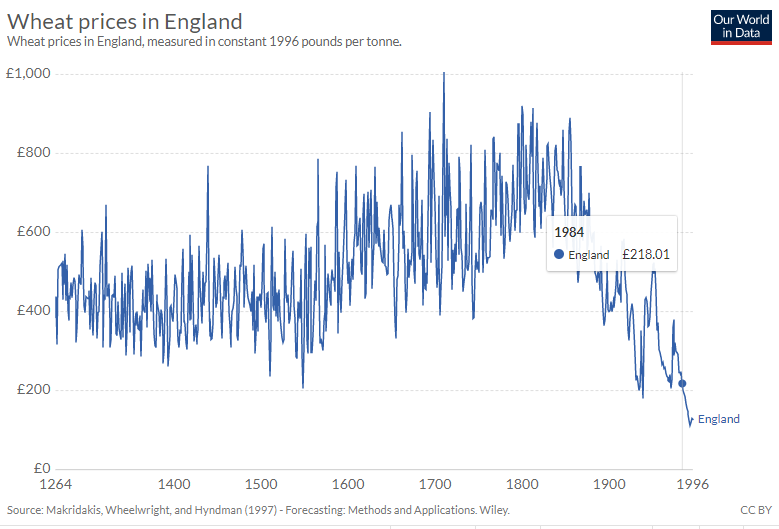
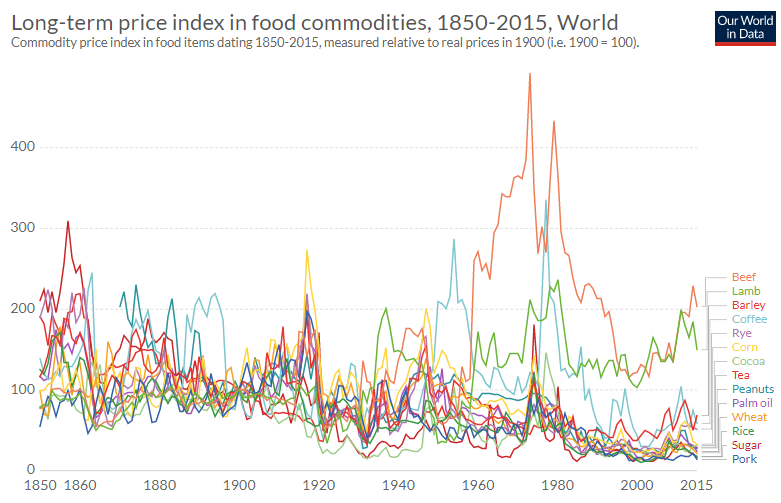
But perhaps John underestimates the power of scarcity. It’s not like anyone farms anymore, yet, everyone seems as busy as ever. However, according to one source, the average workweek (70 hours) has dropped almost in half since the early 1800’s, yet people “think” they are busier than ever. Ignore the fact that the average American spends almost 40 hours a week in front of a screen now, and perhaps life is as hard as people believe it to be.
Plato argued in The Republic that material wealth could cause imbalances in individuals and society, corrupting the soul and leading to disharmonious behavior.
The Age of Political and Social Competition
If economic needs are met, what does that leave society with? A greater focus on social hierarchies and political gain. It may be for example that people spend most of their time trying to keep up with, or impress others, building their social currency bank accounts, because at the end of the day, most people are quite good at such. This could also occur through substitute activities such as video games (e.g. Ready Player One). Or, it may be that we just compete mostly with virtual friends since they are easier to deal with. I imagine quite a bit of both.
In politics, I believe people will have more free time than ever, and as life gets easier, people tend to complain more, not less, so I think it is not unreasonable to assume that politics will become increasingly fierce as machines create more leisure time to pursue such. I think a lot of cultural topics today are growing for similar reason: more time on hand with less friction to vocalize and disseminate individual ideas rapidly, attempting to gain followers for support in the process. Perhaps this is somewhat behind part of the growth of tribalism when it involves being hostile to outsiders.
The Main Question: Why Do We Need More Abundance?
With the exception of curing and preventing a few diseases, I am not sure why we need more abundance. Does more pleasure mean more happiness? Does one more video game, book, or trip to some exotic land make our lives meaningfully better? Perhaps another shot of your favorite drug does, but I doubt it. Maybe I go against mainstream when I say that happiness is derived from purpose, from a life succeeding against challenges, and from providing meaning to and helping others. Not from one of infinite ease and luxury, which obscures and eliminates these opportunities.
One thing I noticed in hindsight, after having lived near a rich retirement home in California was how so many of the kids there had problems, seemingly tied up in resentment, and the only thing that made sense to me was that they lacked some sort of challenge due to growing up in such a wealthy place. I could be wrong, but that was my observation almost 30 years ago. Well, we are all supremely rich by historical standards, even if we are not rich compared to our neighbors today, but is there a tipping point when a larger area, such as the West, is so rich that it leads to moral, spiritual, and ultimately physical decay? One study suggests that a predictor of success for children in “prosocial, academic ability, peer relationship, and life satisfaction scores” as adults was doing chores (there are others as well 1, 2).
With robots, chores won’t be needed, unless we decide chores will be managing robots to terraform. Personally, I think growing up poor was very beneficial to my long-term perspective on life of humility, simplicity, and gratitude, among others.
The simple fact today is:
AI will give us everything we want to know, but at the price of being able to do anything as it will rob our effort and ability to do anything hard, including human relationships.
If these problems are already starting, perhaps some or most of us do not even recognize it, because although most can see waves, few can see the tide.